AC Won't Cool Below 80 Degrees in Los Angeles
AC running but won't cool below 80 in Los Angeles? Three specific causes affect LA homes differently. Diagnosis guide from C-20 licensed technicians.
Quick Diagnostic Checklist
- 1Check the outdoor temperature at the time of failure
if it only happens above 95–100°F, the issue is capacity (undersizing or coil fouling) rather than a failed component
- 2Check the air filter condition
a fully clogged filter reduces airflow enough to prevent the coil from absorbing heat; replace and give the system 30 minutes to recover
- 3Check that the condenser unit has adequate clearance and airflow
vegetation, fences, or debris within 2 feet of the unit restricts heat rejection significantly in peak heat
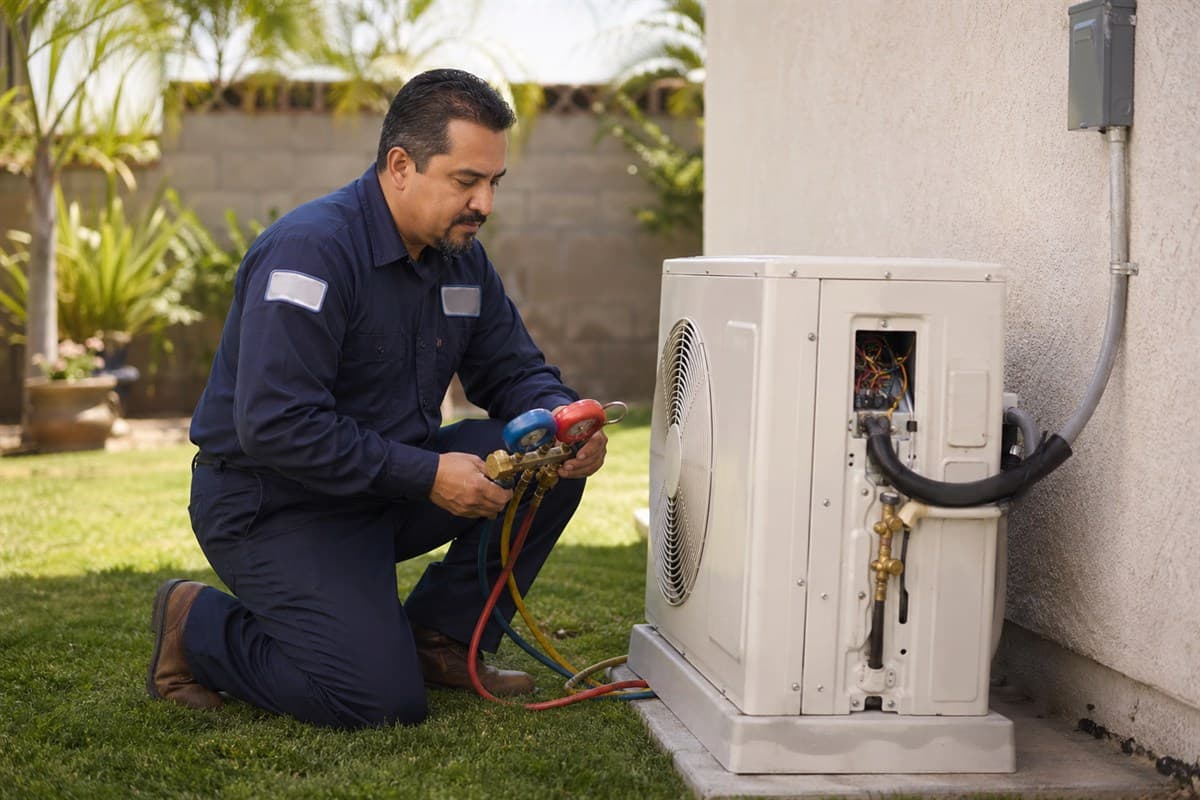
- 4Call a technician to check refrigerant charge and clean the condenser coil
these two fixes resolve the majority of 'won't cool below 80' calls in the LA market
What We Do
A licensed technician arrives in a marked vehicle, performs a full system diagnosis, and gives you a flat-rate quote before any work starts. No surprise charges. Most repairs are completed same day.
The thermostat is set to 72°F. The system has been running for hours. The house is sitting at 81°F, and it has not moved.
This is different from an AC that has stopped working. The system is on. The fan is blowing. The compressor is running. It simply cannot get below 80 degrees. The ac not cooling below 80 degrees los angeles situation requires two distinct responses: first, determining whether this is a genuine system failure or a realistic performance limit — and second, knowing the specific steps that actually resolve each cause.
What "Won't Cool Below 80" Actually Means — and When It's Normal
A correctly functioning central AC system in Los Angeles should maintain indoor temperatures roughly 20–25°F below outdoor temperature under typical operating conditions.
At 85°F outside, a properly sized and functioning system should comfortably reach 68–72°F indoors. At 95°F outside, 72–75°F is the realistic target. At 105°F or above during a heat event, 78–82°F indoors may represent a system working near its design limit — not failing.
This context matters before you make decisions. If it is 85°F outside and you cannot get below 80 indoors — something is wrong with the system and it should be serviced. If it is 108°F during a record heat wave and you are holding 81°F with the system running continuously — your system may actually be performing correctly.
A Practical Self-Test Before You Call
Do this before calling a technician: hold a digital thermometer in front of a supply vent for 60 seconds. Then hold it at the nearest return vent. The difference between return air temperature and supply air temperature — called the temperature split — should be 14–20°F on a properly functioning system.
If the split is under 14°F, the system is not performing correctly — suspect low refrigerant, a dirty evaporator or condenser coil, or a failing compressor.
If the split is a normal 16–20°F and you still cannot get below 80°F on a moderate-temperature day, the problem is the heat load on the house, not the system's output. Insulation, attic heat gain, and window exposure are worth investigating.
When "Can't Get Below 80" Is a System Problem
If the gap between outdoor temperature and your indoor temperature is less than 20°F on a day where outdoor temps are below 100°F, one of three specific causes is almost always responsible.
Low refrigerant. Refrigerant level directly affects cooling capacity, and the relationship is not linear — a system significantly low on refrigerant loses a disproportionate amount of cooling output. A system that barely kept up last summer and cannot reach 80°F this summer under the same outdoor conditions has very likely developed a slow refrigerant leak. This is diagnosable in a single service visit and fixable in most cases.
Dirty condenser coil. A fouled condenser coil reduces the system's ability to reject heat to the outdoor air. Under moderate conditions, a dirty coil may go unnoticed. Under peak load — 95–100°F — the difference between a clean coil and a dirty one can be the difference between reaching 75°F and stalling at 82°F.
Undersized unit. Some LA homes have never quite reached the thermostat set point on the hottest days. If this has been the pattern every summer since installation, the system may have been undersized from the start. Demand for cooling in LA's inland areas has grown faster than many installations anticipated, and systems sized to pre-2010 design conditions are increasingly challenged by current peak temperatures.
When the System Checks Out Fine But You Still Can't Get Below 80
If you have already had a service visit — refrigerant is at correct charge, coil is clean, capacitor and motors are healthy — and you still cannot get below 80°F on moderate-temperature days, the next step is a load calculation.
A Manual J load calculation determines the actual cooling requirement of your home in BTU. In Los Angeles, this accounts for ceiling height, window area and orientation, insulation levels, internal heat gains, and your specific climate zone. The San Fernando Valley, the Westside, and coastal neighborhoods are meaningfully different climate zones with different cooling requirements.
If the calculation confirms the system is genuinely undersized, the options are a replacement system sized correctly, supplemental ductless mini splits in the zones that run hottest, or structural improvements — attic insulation upgrade, solar window film — that reduce the load on the existing system.
What It Will Cost to Fix
| Issue Found | Typical Cost in LA | |---|---| | Condenser coil cleaning | $150–$300 | | Refrigerant recharge (R-410A, minor top-off) | $250–$500 | | Refrigerant leak repair + recharge | $400–$900 | | Load calculation + system sizing review | $150–$300 | | Ductless mini split (for hardest-hit zones) | $2,500–$5,000 installed | | New system (if genuinely undersized) | $7,000–$13,000 |
Get a diagnosis before making any major decision. Most cases of "won't cool below 80" in Los Angeles are resolved with a coil cleaning and a refrigerant check — a C-20 licensed technician can complete both in a single visit.
Frequently Asked Questions
Related Pages
Get a Free Estimate Today
Talk to a licensed C-20 technician — no pressure, honest answers.